Meet Laura – or “Hugo’s in lurve”
Not a dog this time, but a fellow practitioner. Laura is one of Elizabeth Whiter’s Healing Animal Organisation’s graduates (http://www.healinganimals.org/) who attended the HAOK9 Relax Level 1 Diploma module that we’ve written and delivered specially for the HAO. She’s coming along to the Level 2 diploma in a few weeks and wanted to shadow me before then.
I thought that the Weimaraner brothers of Luther & Hugo would be a good shadow as they’re both very used to physical therapy and, being big boys, have a lot of body to work with.
As it happens, Hugo decided to pick up a limp on the morning of the session. That meant that instead of Laura just watching, she could use her skills to help Hugo. Hugo is a lovely boy, but his size can be imposing. However, he fell in love with Laura immediately, lying down with his head on her lap, silly grin and closed eyes.
Using her energy skills as well as hands-on physical therapy, Laura quickly picked up where he wanted some help. Starting lightly, she was soon directed by Hugo how deep she could massage him. He was in bliss. Soppy face throughout, looking up at her with goo goo eyes.
As I’ve said many times, all the complementary therapies have their place. Mixing and matching these therapies can often be more effective than one at a time. Hugo certainly seemed to believe that was the case.
We know that massage & physical therapy work (otherwise we wouldn’t be doing it) but some folk still need convincing. Here is Coco who clearly shows how just a couple of treatment session plus homework from her Mum, helped her recover full mobility.
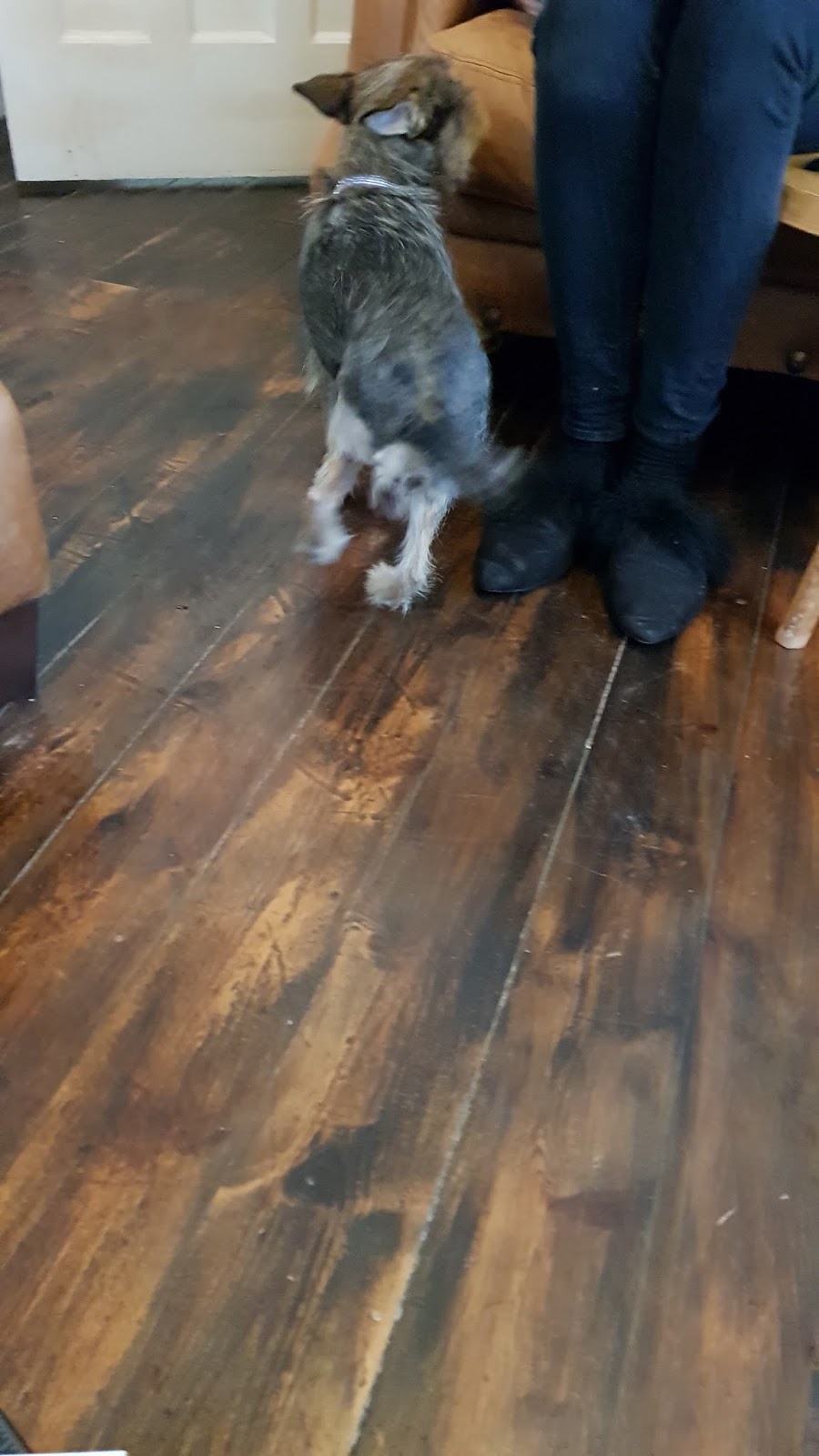
Coco is a 3 year old Schnauzer / Chihuahua cross who recently had an accident which broke her left tibia. It was successfully repaired at the end of January with a pin placed into tibia and a plate in the medial aspect of bone.
She was walking almost immediately on the affected leg but after a week she stopped using it and that leg became non-weightbearing with resultant muscle loss and over compensation on her other three legs.
It is evident from the pictures and videos that she didn’t want to use both hind legs, preferring to hop.
Chris was invited over to try and encourage Coco to use her left hind leg again and help to regain her confidence with all legs before a second X-Ray in a couple of weeks.
She was very responsive to Chris’s touch and rehab exercise routine. He helped her stand squarely before gently raising her ‘good’ hind leg while supporting her, encouraging her to place her weight back on the affected one. After a while the left hind leg was considerably straighter and placed on the floor. A big problem was the slippy laminate floor. Coco’s recovery would be slower if she keeps slipping while trying to stabilise her gait.
Massage to her thigh and gluteal muscles was another main part of the therapy session, helping to build them back up again to, again, rebuild her confidence and ability to stand on all fours. Equally important was maintenance massage to her shoulder and neck muscles which had been taking a lot of the compensatory strain.
One week later and Coco’s Mum has been doing her homework diligently. It was so evident.
Coco came bounding to meet Chris looking far more comfortable. And then there was the appearance of a rug!!!!!! Coco was happily standing and not slipping. That is not just a good Mum but a great Mum.
Muscle mass was evident on her affected thigh and the shoulders, which were tight through compensation, were looser.
During the massage routine, far less fur was coming off too. Dogs tend to hold their anxiety in their fur and often shed bucket loads in the first massage. But as they relax, any myofascial tension is relaxed allowing blood and nutrients to get back into the skin and fur. This is frequently demonstrated by less shedding during the massage.
Coco is hopefully well on the road to full recovery. Certainly, both she AND her Mum were far more relaxed. With just a couple of physical therapy sessions and a Mum empowered to keep up the good work, that is a job done.
Does massage and physical therapy work? Well here are a couple of responses from caers of dogs we have treated in the past.
Sonny's Mum, who we helped back in June last year after Avascular
Necrosis affected both his hip joints and had Femoral Head Excision on
both hips, wrote after reading the post yesterday “Oh it definitely
works. Sonny is living proof of that thanks to you  💙”
💙”
And the final word needs to go to the Lord Nelson's Dad who is a lawyer Dad of Lord Nelson " Does
massage and physical work? Exhibit A - Pre AchyPaw: Lord Nelson could
hardly put weight on his back legs especially when he first got up. Had
difficulty jumping up and could only manage stairs one step at a time.
Vet confirmed no physiological damage.
Exhibit B - Post AchyPaw: he now hops on and off the sofa without any
problem, goes up and down the stairs one leg at a time like other dogs,
even his posture is different, and is a much more lively dog. I rest my
case ’mlord"
I’ve been visiting my Luther for over two years now. When I first visited, his Dads and vet were running out of options for his arthritis. But he responded so well to physical therapy from me weekly and his Dads daily he’s now had his 12th birthday.
Several interventions have been added to his treatment regime, both pharmacological and complementary. He is off Tramadol and on Rimadyl and Paracetamol. He goes to hydrotherapy weekly. His daily walks have been realistically reduced - not stopped. And he’s happy.
Last week he had a wobble when his front legs couldn’t quite support him. I was asked round for some emergency care. Poor chap did not look happy but allowed some physical help. We looked at supports and I mentioned the OrthoPets Help ‘Em Up harness which Fin uses. We see Fin daily and it’s made a lot of difference just having that extra help when he squats or has a little wobble.
Today I visited Luther again and he was proudly wearing his harness. His Dad calls him RoboDog. It looked complex to put on but is quite simple. And most importantly it gives Luther confidence. As I was leaving he was tentatively standing inside the front door, looking to come out to say goodbye. All it needed was a helping hand from Dad - not a yank or a hold but a confidence boost. He came out and I got my tip, a goodbye kiss from Luther.
You don’t want your dog to think that they have failed by not being able to stand, but that Dad and Mum are there just to give them that supportive boost. Think how many times our dogs give us their helping hand - when we’re down or just because we need it. Giving them back some extra help in their senior years goes some way to redress the extra hand, or paw balance.
Your dog is a family member. If one of your two-legged family members had a mobility issue (and that includes crawling babies) you’d do the best to make things safe for them. The same should be for your four-legged friend. When we make our AchyPaw Canine Physical Therapy home visits, we don’t just offer massage and exercise advice, but also give advice on appropriate home adaptations which might help their dog feel more comfy and safe.
Here is a simple A, B, C to help make some improvements.
A is for ACCESS. How many steps and stairs does your dog walk up and down daily in your house just to get around or to get in and out? Are they human sized steps? You can make simple and inexpensive improvements to ease their access.
If you’ve got full sized stairs, buy some Half Steps (they are used for human mobility aids). We’ve got an old house with clumsy sized steps. No more – we have half steps everywhere which are more dog sized. Some are bought, some are home made. The dogs don’t seem to care how expensive they are, just how safe they now feel. And they must work as when we have canine visitors to our house, they always go straight to Sarah’s Steps rather than the bigger ones.
Sometimes, a ramp might be necessary. There are many varieties available but check the size and weight they can hold – and how manageable they are for you - or you might not use them. You could even make your own. To get from our back door to the car, there were many different sized steps. We made a ramp by cutting decking planks to size, fixing them to a frame, and placing it over the offending steps.
If your dog goes up and down stairs on their own but is now getting a bit wobbly, buy a stair guard to put up when you’re out so they don’t try to climb and fall down.
B is for BOREDOM. If your dog is slowing down a bit in their senior years, you can hide the ball that finds its way under the sofa and introduce some Mind Games. Again, you can find all sorts to buy or make one with tennis balls in a muffin tin with treats hidden underneath. The dogs will spend ages picking out the balls to get to the treats. Snuffle Mats, perhaps hiding low calorie treats, can encourage mind stimulation.

C is for CARPETS or lack of. This is the top way to keep your dog injury free according to Natalie Lenton of the Canine Massage Therapy Centre (http://www.k9-massageguild.co.uk/the-number-1-way-to-keep-your-dog-injury-free/). I know, laminate floors are easy to look after, but they can be very tricky to navigate if you’ve got aging joints or small paws. You don’t need to completely carpet your house, just provide islands of runners and mats so the dogs can get safely from their bed, to the door, to their food bowl. Otherwise, to the dog, it can be like walking over a glacier. I always carry a number of carpet runners in my car for visits for demonstration. Every time the dogs see it, they walk straight to it and on it.
D is for DRIVING – (you not the dog). You’re going to take your dog for a walk. How do you get them in the car? If they are light enough, you can lift them. But this is not always possible. Again, there are many ramps and portable stairs to help them get into the car. The main requirement for me when I bought my new car, was the height of the boot. Not too high and enough to fit our drive perfectly. We even built a bridge for the dogs to get in and out. Simple but effective. While you’re there, warm them up before you drive them for their walk and cool them down when they’ve finished. We use the simplest but effective warm-up / cool-down called the Locomotion.

E is for EXTRA HELP. Some dogs with mobility problems or getting senior, find it hard to get up from lying down. Try a harness. There are several that have handles front and back which will give your dog that little extra assistance and thus confidence to stand up. Some can even be left on all day but check out how comfy they feel before you do. If you haven’t got a harness, a towel or a strong scarf also works wonders.
F is for FOOD BOWL (and water bowl). Try this. Get on all fours. Imagine your food is on the floor. Bend down to reach it. Ouch – your neck starts to hurt, your back aches. If that food was raised a few inches it would make the whole process easier and comfier.
Z is for ZZZZZZZZZ (sleep and bedtime). Is your dog sleeping comfortably? Try sitting on their bed for a while. Do you feel a bit numb? It might be the bed needs more padding, to be firmer or perhaps a memory foam mattress. Again, you can buy all sorts of these or make them yourself. We bought some memory foam offcuts, some cheap bed covers, cut the foam to size, slip them in the covers, dogs love them.
A few simple but effective ways to help your dog feel safer getting around and about the house.
As well as offering education, physical therapy and massage, exercise advice and rehabilitation, we also have lots of useful suggestions for carers. This makes for an all-round Complementary Therapy for their dogs. I know some people tend to put quotation marks around Complementary Therapy or do those finger things in the air when talking about it as though it is whichcraft or dodgy. I’ve never understood why, as it is what is says – complementary therapy to that already being received. Most often, this is traditional pharmaceutical treatment prescribed by the vet. That should always be the first port of call. Anything else can add to or complement that.
The Cancer Research UK site (http://www.cancerresearchuk.org/) has a clear definition worth copying in full :
“A complementary therapy means you can use it alongside your conventional medical treatment. It may help you to feel better and cope better with your cancer and treatment.
An alternative therapy is generally used instead of conventional medical treatment.
All conventional cancer treatments, such as chemotherapy and radiotherapy, have to go through rigorous testing by law in order to prove that they work. Most alternative therapies have not been through such testing and there is no scientific evidence that they work. Some types of alternative therapy may not be completely safe and could cause harmful side effects.”
Over the years of managing our dog’s various issues, and most recently Sarah’s arthritis, we’ve tried several complementary therapies allowing us to offer experience and advice. She’s had acupuncture from vet Guy at Coastway. Sam has had Cartophen injections. Sarah has had laser therapy. They have both had, and still do have, homeopathy from Tim Couzens of the HVMC and energy healing from Louise Wilson of Touch of Reiki.
One that adds perfectly to their massage and physical therapy, and one used by many of the dogs I work with, is hydrotherapy.
This addition made a considerable difference to our Sarah’s movement as well as to her fitness. At first, she could only manage once or twice round the pool at Coastway Vets and was totally exhausted when she came home. But that gradually built such that the therapist was able to do several laps non-stop with her.
Unfortunately, she had a bit of a crisis 18 months ago and her back legs failed. After medication and other interventions, we started on twice weekly hydrotherapy at House of Hugo with Mia.
This is a bigger pool which she seemed to prefer. We’re now down to weekly sessions and while she may not get into the pool with a big smile, she does it. She knows the way out. She knows where the exit ramp is. But she is happy to swim up and down with Mia helping and coaxing. She even allows Mia to ‘float’ her back to the start – which I think is probably her favourite part of the session as she lies in her arms like a Princess.
I thought that the massage and exercise she was getting was enough. So, when we had to cancel a couple of sessions over Christmas, I assumed she’d be able to get straight back into the swim. But no. She was far more tired out on that first visit back after 3 weeks. Puffing and panting within 10 minutes. She needed a lot more rest and float time.
It reinforced that if you find something that works, keep at it. Don’t assume you can drop this or that therapy – whether complementary or traditional – and your dog will be fine. It is rather like going back to the gym after a 2 week break. The cardiovascular exercise she was getting from her regular walks with us, was clearly not quite enough. Her body had got used to this weekly shot of non-weightbearing exercise. I’m confident that by the end of the month she’ll be back to her usual 30 minute hydrotherapy. Still not loving it, but doing it as she knows it’ll do her good.
If you think it would help your dog, see if you have a local hydrotherapy pool which you could go to. It could be the thing that really helps – the perfect complement.
I love the fact that we dog carers go to extra lengths to make our dogs comfy. The award of the year for 2017 has to go to Corkie’s Dad. He has built him a Corkie Stair Lift.
Corkie is a 12 year rescue who spends all his time with his Dad. Recently he started to show signs of slowing down and discomfort so was taken to the vet who suggested there was some arthritis in his mid-spine. Shoulders and hips felt fine though.
Corkie lives in a lovely house which unfortunately has many flights of narrow stairs to get to the top floor. There was no way his Dad could ask him to continue climbing those. He had to be carried. But it was a long way. His Dad would end up doing his own back in which would be bad news for both. Also, picking Corkie up the wrong way could make his spinal issues more uncomfortable. It would only need him to wriggle or twist and that would exacerbate his arthritis. Cue some wonderful resourceful inventiveness. His Dad came up with the Corkie Stair Lift (CSL).

The inspiration was a basket used to carry things – but with an extra twist. CSL Mk1 was a bit heavy and clumsy. He’s now on CSL Mk2 which is a wooden lightweight open ended carrying frame with a fluffy cushion for Corkie to sit in. A treat is inserted into the frame. Corkie enters the frame. Corkie lies down. Dad carries Corkie in the CSL down the stairs. At the bottom, Corkie walks out of the CSL into the hall. No effort on his back.
How amazing is that? Much admiration to Corkie’s Dad.
Apparently CSL Mk3 is on the cards which will be a lighter slightly thinner version so Corkie fits snugly inside. Corkie’s Dad’s inventions are going to be bigger than Bitcoins next year!
Meanwhile, Corkie is up for complementary therapy to help him manage his arthritis. He is already on supplements. As well as the CSL ©, carpets are now being used to cover the wooden floors. Food bowls are raised. And a ramp has been bought for the car.
All that is left is a massage lesson – which was why I was called round. That was my job for the day.
After a quick tour of Corkie’s body, his Dad started working with him. If Corkie could speak, he would have said “At last Dad….at last. That is sooooooo good”. Corkie is the new definition of receptive. We knew exactly where he needed his help – mainly along his stiff back muscles. Every time his Dad hit the spot Corkie closed his eyes in ecstasy and grinned.
In fact, by the end of the 2 hour session, Corkie decided that anywhere was good. Anywhere and everywhere. Thighs. Shoulders. Neck. Chest. Just bring it on Dad.
When we’d finished, Corkie was prancing around the room looking so much happier and flexier.
But this session was not all about Corkie. His Dad needed to feel that he could do something for Corkie. I think this was a result too as he said "I now feel inspired to help Corkie". That's my job done.
With this early diagnosis from the vet, daily physical therapy from a wonderful inventive Dad after our guided instruction session, some recommendations on exercise and other therapies, plus Corkie's receptive nature, this little fella should be looking at a comfortable 2018 with lots of fun and walks.
Well…..there’s a first
When we got to the Park this morning at 7:00, the temperature was below zero and it was very frosty. So, after getting the dogs out of the back of the car, we did our Locomotion routine on them.
A lady, who’d just drawn up, got out of her car and said, in a quizzical unbelieving voice “Wait……did you just warm-up your dogs?” The reply came in stereo from us “Yes” in a why-not tone of voice. Chris had been warming-up Sarah and I’d been warming-up Sam.
She was then more than interested to find out what we’d been doing. I explained that we designed the quickest effective warm-up routine in Sussex which we call The Locomotion. After waving my hands in the air, showing her how to do it, I explained that the dogs love it. It’s fast. It’s very warming. And if you sing a warmy-up song while doing it the dogs add to the routine by becoming bouncy.
I explained the song lyrics doesn’t really matter – she started singing “The Wheels on the Bus Go Round and Round” If you turn up the volume on the video here , you’ll hear the booming voices of the Healing Animal Graduates with their rendition of the Locomotion. (Yes, the AchyPaw workshops are full of fun and interaction while you’re learning). Or you can simply make up your own song. Mine….it’s a rubby dubby song.
As long as you warm your dog up before exercise – even a walk – especially on these cold days and nights, it can help to prevent injuries from cold muscles. Like our Locomotion routine, it doesn’t need to take ages, and the dogs get to expect it, even asking for it – standing still after they get out of the car until they’ve had their warm-up. They are clearly more sensible than us.
My mission for 2018 has now expanded. Added to my first mission to help all caring owners become aware of early signs of arthritis or other mobility issues teaching them how to help their dogs before these problems become chronic, is to share and spread the importance of warming their dogs up, and, of course, cooling them down afterwards. It’s quick, it’s easy, it’s efficient, it’s The Locomotion, it’s all part of our service.